

Binsey Poplars
O if we but knew what we do
felled 1879

My aspens dear, whose airy cages quelled,
  Quelled or quenched in leaves the leaping sun,
  All felled, felled, are all felled;
    Of a fresh and following folded rank
                Not spared, not one
                That dandled a sandalled
         Shadow that swam or sank
On meadow & river & wind-wandering weed-winding bank.

  O if we but knew what we do
         When we delve or hew —
     Hack and rack the growing green!
          Since country is so tender
     To touch, her being só slender,
     That, like this sleek and seeing ball
     But a prick will make no eye at all,
     Where we, even where we mean
                 To mend her we end her,
            When we hew or delve:
After-comers cannot guess the beauty been.
  Ten or twelve, only ten or twelve
     Strokes of havoc unselve
           The sweet especial scene,
     Rural scene, a rural scene,
     Sweet especial rural scene.
My husband is a member of ISCAST, an Australian group that brings together scientists and Christian theologians who are both scientifically-minded and theologically-inclined—just like him. The group includes many fascinating and dynamic people, and I enjoy attending some of their sessions, even though I am neither a scientist nor a theologian.
One such person is Tony Rinaudo, an ISCAST fellow. His remarkable story of regenerating large swaths of Niger—over 5 million hectares—is awe-inspiring. His system has been implemented in other parts of Africa and around the world, and the difference it has made is so significant that it can be seen from satellite pictures.
It all began with a moment of despair. Tony had spent a long time trying, unsuccessfully, to plant trees and seedlings in Niger, with little help and seemingly no hope. The vast, dry, semi-desert landscape seemed impossible to overcome. One day, while stopping to check the pressure in his vehicle’s tires, he knelt beside his car and poured out his despair to God in prayer. He prayed for forgiveness, both for himself and for those around him, for the devastation they had caused to the land.
When he finished his prayer and stood up to return to his car, he noticed a bush nearby. Upon closer inspection, he realized it was a tree that had been cut down to the ground but was now slowly regrowing. Looking around, he saw that there were many such trees nearby—large numbers of them that had been cut down over decades. It struck him that if he could persuade the local landowners to allow these trees to regrow, there would be no need to plant new ones or seedlings. Through persistence, persuasion, and the development of a system that facilitated regrowth, Tony helped regenerate the land. This effort led to higher yields for local farmers and graziers, along with increased rainfall.
Tony’s faith and grief over the devastation caused by deforestation were the driving forces behind what he did. This deep sense of grief is echoed in the poem Binsey Poplars by Gerard Manley Hopkins. In the poem, Hopkins expresses his sorrow over the felling of a specific grove of trees.
At first, he compares the trees to soldiers who have been slain, using a personification similar to Psalm 1, which describes a righteous man as being like a well-watered tree planted by a stream. Hopkins then describes the irreversible loss of sight that occurs when an eye is damaged, no longer able to perceive beauty—only memory remains. The loss of the trees is similar, as their beauty is no longer visible; only the memory of it remains.
The most poignant line in the poem comes toward the end, where Hopkins laments that future generations will never see the beauty he once knew—beauty he still deeply longs for and grieves.
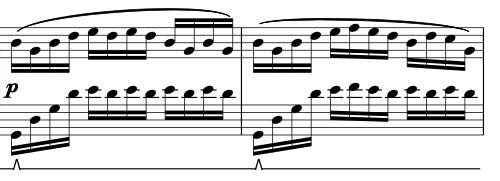
So in writing the piano piece I started with a texture idea to convey trees swaying in the breeze:
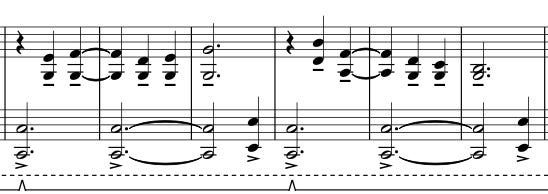
then shifted to a sombre theme representative of the line, "All felled, felled, are all felled;
After combining both themes, I return to a quiet, eerie version of the sombre theme to explore the emotion of loss and devastation present in the poem. This then morphs into a hopeful passage full of nostalgia recalling what once was,
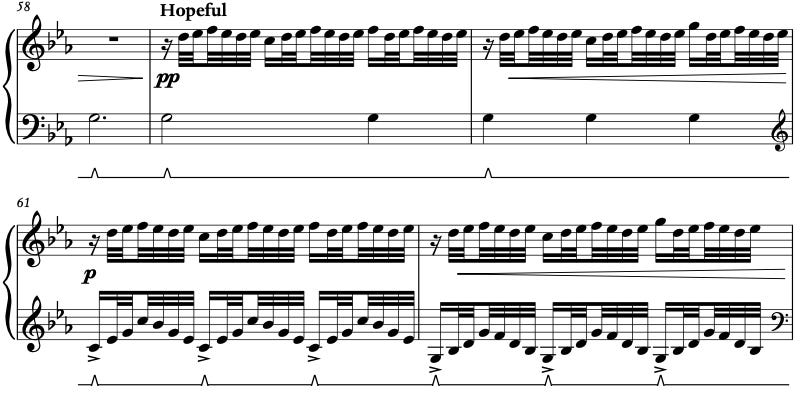
only to return to the sombre theme conveying the reality of what is.
Below you can watch a video of the piano piece with the score.

Naomi Brown